
Multiscale Modeling with Abaqus
Linking Micro and Macro Scales to Predict Composite Behavior
February 11, 2027 at 1:00:00 AM
Time & Location
11 Feb 2026, 8:00 - 9:00 CT
Online Training
About the Event
Composites Don't Behave Like Single Materials, and Modelling Them Shouldn't Pretend Otherwise
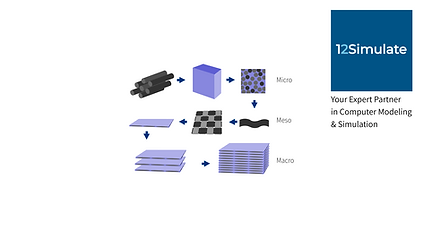
A composite's macro level behavior is inseparable from what happens at its microstructure, in the matrix, the fibres, and how the two interact, which makes composites inherently multiscale by nature. Treat one as a single homogeneous material and you risk missing nonlinear or history dependent effects; try to model every fibre and matrix interaction in full detail instead, and the computational cost quickly becomes prohibitive. Multiscale modelling bridges that gap by linking micro and macro scales through dedicated techniques, keeping macro level predictions tied to what's actually happening in the microstructure.
Webinar Scope
This training introduces multiscale modelling of composites in Abaqus, centered on Mean Field Homogenization (MFH) and its FE based alternative. You'll see how information moves between micro and macro scales, how a composite's microstructure gets specified, and how both linear elastic and nonlinear short fibre reinforced composites are modelled. The Micromechanics plug in also gets covered, which automates Representative Volume Element (RVE) model creation and postprocessing.
Topics Covered
Multiscale modelling fundamentals: bottom up and top-down scale communication
MFH versus FE-RVE: weighing accuracy against computational cost
Specifying composite microstructure: shape, volume fraction, aspect ratio, fibre orientation
Linear elastic composites: Voigt, Reuss, Mori-Tanaka, and balanced formulations
Multi-step homogenization for multi-inclusion or dispersed fibre composites
Composites with thermal expansion
Incremental MFH for nonlinear composites: plasticity, damage, and viscoelasticity
How isotropization methods affect prediction accuracy
Requesting output at micro and macro level
Generating and postprocessing RVEs with the Micromechanics plug in
Deep Material Network (DMN): a reduced order, machine learning based approach for multiscale material modeling
Who Should Attend?
Simulation engineers modelling composite or fibre reinforced materials
Analysts working with short fibre reinforced or multi-inclusion composites
Engineers looking to predict macro behavior from microstructure data, or vice versa
Anyone evaluating MFH as an alternative to full FE-RVE modelling
Prerequisite
12Simulate Abaqus customer
